Library of Maria Valtorta Journal Entries
Welcome to the LIBRARY of Journal Entries, part of an archive of Maria Valtorta journal entries. The most recent are highlighted here. Each entry includes a PDF, MP3 audio, answered questions, and thematic notes drawn from excerpts in Maria’s writings. Entry excerpts may appear random or follow a sequence of Anonymous’ readings.
How To Use These Journal Entries
Below each entry, you will find questions answered by a specific Maria Valtorta excerpt included with the entry. For additional answers, and other indices by PDFs found at Library > aBooks.
Journal Thematic Content and Topical Index
For more thematic detail, visit the valtortaj.net Journal Thematic Content PDF. It is arranged by entry date and includes journal PDF and MP3 audio links. The valtortaj.net Journal Topical Index PDF, arranges topics alphabetically linked to the journal PDFs and MP3 audio.
Journal Entry #20, November 16, 2026
Answers To Theses Questions:
- How can the faith and purity of one person genuinely transform the soul of another who was once shrouded in error and wrath?
- What does it mean to die peacefully when one has lived entirely by faith, with human pain fused to supernatural rejoicing?
- Is marriage truly a sacrament of mutual spiritual elevation in which the better spouse draws the other toward God?
Journal Entry Themes:
The Power of Virtue in Elevation of Marriage
Describes how Cecilia’s virtuous conduct transformed her husband Valerian, illustrating that personal goodness can positively influence others, making marriage a partnership for mutual improvement.
The Impact of Faith on Martyrdom
Chronicles Cecilia’s serene acceptance of martyrdom, highlighting her faith’s role in transcending physical suffering and maintaining spiritual joy, even in the face of persecution.
Early Christian Rome's Social Transformation
Details the conversion and subsequent lifestyle changes of Valerian and Tiburtius, showcasing the early Christian community’s shift towards charity and modesty, reflecting broader social changes.
The Role of Music in Christian Devotion:
Notes Cecilia’s musical talents and her use of music in worship and teaching, explaining her patronage of music and the spiritual significance of her musical abilities in early Christian practices.
The Sacrament of Marriage as a School for Elevation
Explores Jesus’s perspective on marriage as a means for mutual spiritual growth, emphasizing the importance of marriage as a holy and elevating institution rather than a source of corruption.
Journal Entry #19, November 11, 2026
Journaler's Synopsis:
Among other matters regarding Mass in the catacombs and a Christian woman’s marriage to a pagan, Maria records Jesus directly addressing the modern reader near the end of the dictation: In the decadent world, not only does virginity seem like an obsession, but chastity in marriage, continence, which makes man, Man and not a beast, is no longer regarded as anything but weakness and impairment. This line strikes at the core of how society views self-control today. It suggests that our current culture doesn’t just ignore discipline; it actively mocks it, treating the ability to say no to immediate physical gratification as a defect or a sign of being broken, rather than a strength.
For the common man, this isn’t about religious rules or old-fashioned morality; it’s about spiritual purity, the opposite of feeding the fleshly appetites that kill the soul, the divine spark with in us. The dead soul dies with the dead flesh eternally. So, the text argues that the beast inside us—the part that wants everything right now—is always there, but what makes us human is our ability to govern it by the dictates of a living spirit, or soul. By calling continence a weakness, modern society has confused ease with virtue. This statement demands we ask ourselves: Are we in charge of our lives, or are we just passengers on the ride of our own appetites? It’s a call to reclaim a lofty, loving dignity through discipline of heart, mind, and soul: the Great First Commandment, because we are not animals.
Journal Entry #18, October 28, 2026
Answers To These Questions:
- Why does a guardian angel remain beside a suffering human soul in its darkest hour of spiritual solitude and doubt about its divine mission?
- What is the nature of the human body as a temple in which the Father, Son, and Holy Spirit dwell through indissoluble union?
Maria Valtorta Journal Entry Themes:
The Concept of Sin and Divine Occupation
Explores how sin evacuates divine presence but leaves behind a sacred residue, making the human body a haunted house sacred by its past occupancy.
Guardian Angel's Emotional Response to Sin
Describes the guardian angel’s feelings of sadness and continued veneration for the sinner, despite the absence of divine presence, drawing parallels to a cherished place now profaned.
Theology of Absence and Vulnerability
Discusses the provocative idea that God is not omnipresent in sinners, instead being expelled like a guest from a desecrated room, suggesting divine vulnerability contingent on human morality.
Angel's Role in Infusing Hope
Highlights the guardian angel’s mission to instill hope in the believer, emphasizing the importance of this virtue amidst spiritual struggles and the cross of life.
Visual Imagery of the Guardian Angel
Details the angel’s appearance and demeanor, including his kneeling position, emerald robe, and ruby mantle, symbolizing respect, love, and hope.
Maria's Personal Reflection on Loss
Relates Maria’s experience of selling a family home filled with memories, paralleling God’s and the angel’s feelings of sadness and veneration for the sinner.
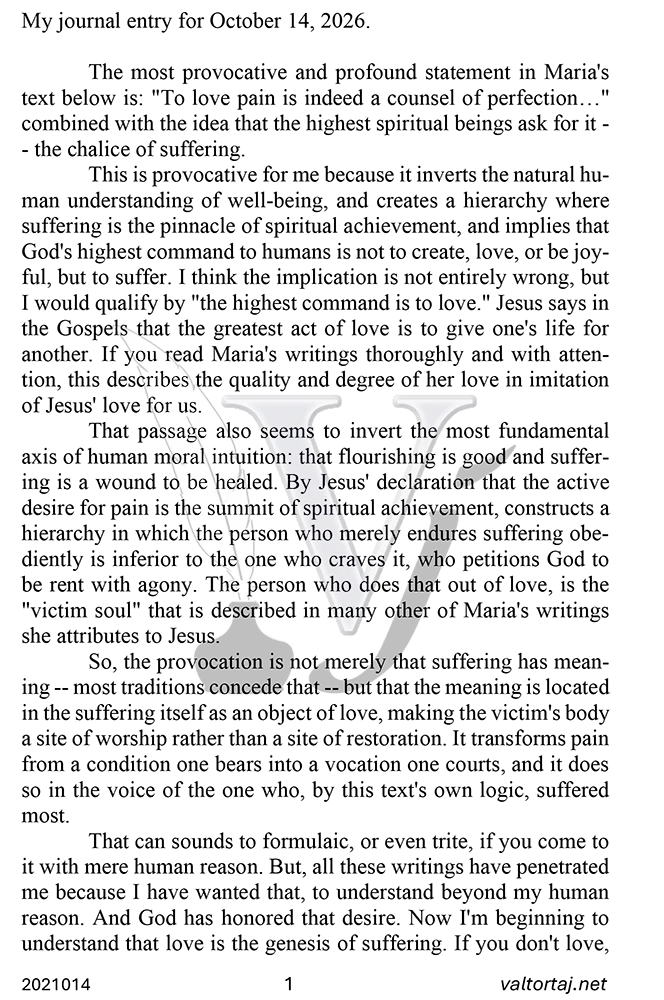
Journal Entry #17, October 14, 2026
Answers To These Questions:
- How can a human soul find the strength to love and embrace prolonged, gnawing suffering rather than merely enduring it in obedience?
- What is the nature of the eternal present in which God exists beyond all past and future moments of creation?
- What is the perfection of joy that a blessed soul experiences in the eternal embrace of the Triune God?
Maria Valtorta Journal Entry Themes:
The Spiritual Value of Willing Suffering
Explores the idea that suffering, when embraced out of love, becomes a form of spiritual achievement and a means to divine communion, challenging traditional views on human flourishing.
Hierarchy of Spiritual Love Through Pain
Describes a spiritual hierarchy where those who actively desire and petition for pain, out of love for others, are considered the most spiritually advanced, embodying the essence of Christ’s love.
Eternal Time and Suffering
Discusses the concept of experiencing time as an eternal ‘now’ to endure suffering, aligning oneself with divine time and transforming temporal pain into a spiritual state of eternal bliss.
Divine Command and Human Capacity
Considers the distinction between God’s command to endure suffering out of obedience and the counsel of perfection to love suffering, reflecting on human capacity and spiritual growth.
The Role of Love in Suffering
Argues that true suffering arises from love, distinguishing it from mere physical pain, and suggests that love is the genesis of profound spiritual suffering.
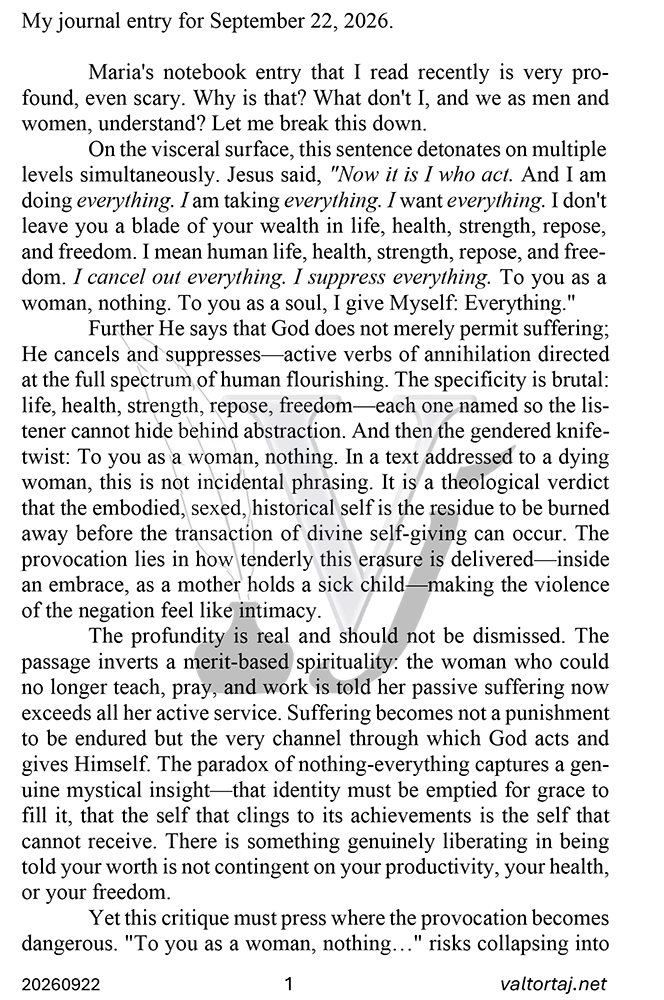
Journal Entry #16, September 22, 2026
Answers To These Questions:
- What power can a solitary human being wield against the combined forces of darkness, temptation, and death that seek to destroy the soul?
- Can the unwavering faith of one pure person truly liberate a soul that has willingly bound itself to the powers of Hell?
- What must a person embrace at the final moment of death to escape the last and fiercest assault of the one who hates them?
Journal Entry Themes:
Theological Verdict on Female Embodiment
Addresses the tension between female embodiment and divine grace, suggesting embodiment is to be transcended rather than celebrated, raising questions about the devaluation of the physical self
Paradox of Suffering and Divine Love
Explores the concept of suffering as a channel for divine love, challenging traditional views on merit and productivity, and offering a profound insight into mystical spirituality.
Christ’s Program of Suffering for the Priesthood
Outlines a detailed plan of suffering for the spiritual well-being of various groups, emphasizing the critical role of the priesthood in spiritual life and the consequences of their neglect.
Divine Love and Human Suffering
Describes Jesus’ intimate and tender approach to suffering, comparing His embrace to a mother’s, and highlighting the transformative power of divine love in the face of human affliction.
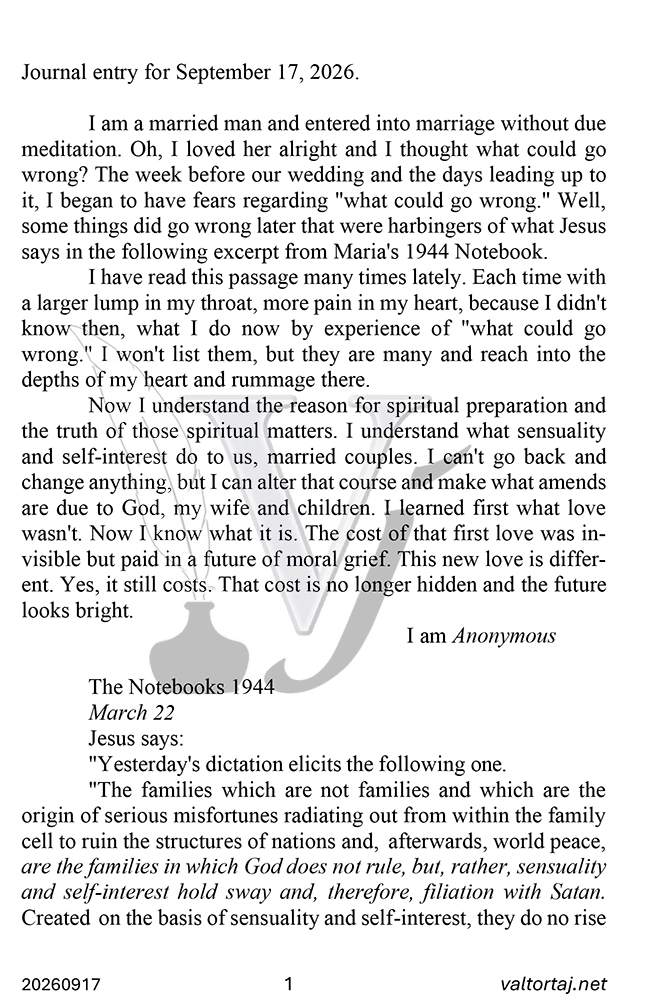
Journal Entry #15, September 17, 2026
Answers To These Questions:
What dignity does God bestow upon a man and woman who unite in upright love to perpetuate the human race and give souls to Heaven?
What happens to the structures of nations and world peace when families are formed on the basis of sensuality and self-interest rather than divine rule?
How does prayer preceding the marital act transform it into something holy, blessed, and fruitful in true joys and offspring?
Journal Entry Themes:
The Impact of Spiritual Preparation on Marriage
Discusses the importance of spiritual preparation in marriage, contrasting marriages based on sensuality and self-interest with those rooted in divine purpose, leading to a more fulfilling and holy union.
The Consequences of Ignoring Divine Guidance in Marriage
Explores the dire consequences of marriages that ignore divine guidance, highlighting how such unions can lead to personal and societal ruin, emphasizing the role of sensuality and self-interest.
The Transformation of Love Through Experience
Chronicles the author’s journey from a superficial understanding of love to a deeper, more spiritual one, illustrating the cost of initial ignorance and the path to redemption and a brighter future.
The Role of Marriage as a Sacrament and Human Union
Elaborates on the sacred nature of marriage as both a human union and a sacrament, emphasizing the creation of new souls and the importance of divine presence in marital life.
The Influence of Sensuality and Self-Interest in Marital Dysfunction
Analyzes how marriages founded on sensuality and self-interest can lead to dysfunction and misfortune, drawing a parallel to the influence of Satan and the importance of spiritual preparation.
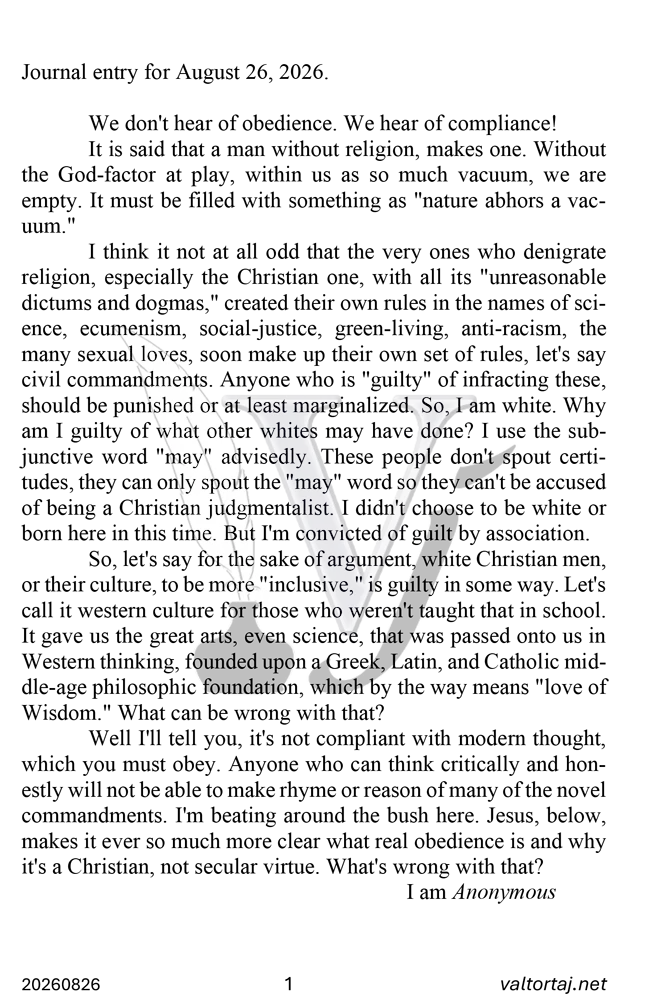
Journal Entry #14, August 26, 2026
Answers To These Questions:
- How does obedience function as the single virtue through which man was both lost in sin and redeemed by Christ?
- What does true religion demand of a person who has reduced their faith to mere sentiment and ritual practice?
- Why do cloistered convents exist as a necessary function within the body of the Church for those who cannot pray?
- How does divine Mercy respond to the growing tide of human crime and disobedience that increases Justice on Earth?
Maria Valtorta Journal Entry Themes:
Obedience as Christian Virtue
Explains the depth and importance of obedience in Christianity, emphasizing Jesus’s role as the embodiment of obedience for redemption and salvation, contrasting it with secular interpretations of obedience.
Guilt by Association in Modern Thought
Explores the concept of guilt by association, questioning its fairness and relevance in modern social movements, particularly in discussions of race and historical responsibilities.
Religion vs. Secular Rules
Discusses the shift from religious obedience to secular rule-making, highlighting how modern secular movements create their own commandments and compliance standards, similar to religious doctrines.
Cloistered Convent's Role in Prayer
Describes the purpose and function of cloistered convents in praying for the world, emphasizing their role in offering praise, reparation, and intercession for various groups and issues, including the Church and humanity’s salvation.
Religious Devotion and Personal Transformation
Focuses on the idea of religious devotion as a means of personal transformation, moving from animalistic tendencies to a more divine state through practices like humility, honesty, and charity, aiming to reach spiritual maturity and eternal life.
Journal Entry #13, August 19, 2026
Answers To These Questions:
What is the underlying meaning behind God’s prohibition of the tree of the knowledge of Good and Evil in Genesis?
What does Jesus explain as the true, exact meaning of the word ‘rule’ as it applies to man’s being?
How does a soul living in grace come to possess God through the Father, the Son, and the Holy Spirit?
Why were Jesus’s martyrs able to become true men and women again through Grace rather than remaining degraded beasts?
Maria Valtorta Journal Entry Themes:
The Concept of Grace and Redemption Through Martyrdom
Explores the profound transformation of individuals into martyrs through grace. Emphasizes their ability to overcome earthly desires and embrace the divine will. Highlights their role in sanctifying the world.
The Nature of Evil and Its Origin in Lucifer:
Discusses the emergence of evil from Lucifer’s pride. Illustrates how this malevolent force spread from the spiritual realm to corrupt humanity. Emphasizes the contrast between divine goodness and evil’s deceitful allure.
The Importance of Inner Dialogue with One's Soul
Advocates for a deeper connection with one’s spiritual self. Suggests that engaging with one’s soul can reveal profound truths and provide spiritual sustenance. Ccontrasts this with the superficiality of earthly friendships.
The Role of Obedience in Christian Virtue
Highlights the significance of obedience in Christian teachings. Draws parallels between historical Christian martyrs and modern believers. Emphasizes the importance of faith and adherence to divine commandments.
The Fall of Humanity and the Consequences of Disobedience
Analyzes the biblical narrative of the fall from grace. Focuses on how humanity’s disobedience led to the loss of innocence and the introduction of sin. Emphasizes the need for redemption through divine grace.
Journal Entry #12, August 6, 2026
Answers To These Questions:
What gives a person the strength to face dislocation, torture, and drowning while smiling?
Can God grant a peaceful death before a trial beyond one’s strength that could crush their faith?
Why does the world neglect or mistreat its saints? But follows those who lead it further into corruption and spiritual darkness?
Journal Entry Themes:
The Martyrdom of St. Phenicula
Describes the intense suffering and steadfast faith of St. Phenicula, a lesser-known martyr. Her spiritual journey to embrace Christ, offers insights into early Christian devotion and sacrifice.
Jesus' Teachings Through Martyrdom
Jesus uses the story of St. Phenicula and her friend Petronilla to impart a lesson. Faith, obedience, and the power of prayer, emphasizes the importance of spiritual life and gratitude.
Obedience and Spiritual Instruction
Jesus instructs the author to write about heavenly creatures and spiritual matters. He emphasizes the importance of obedience and spiritual knowledge in conquering heaven. And He showcases the intricate relationship between divine will and human action.